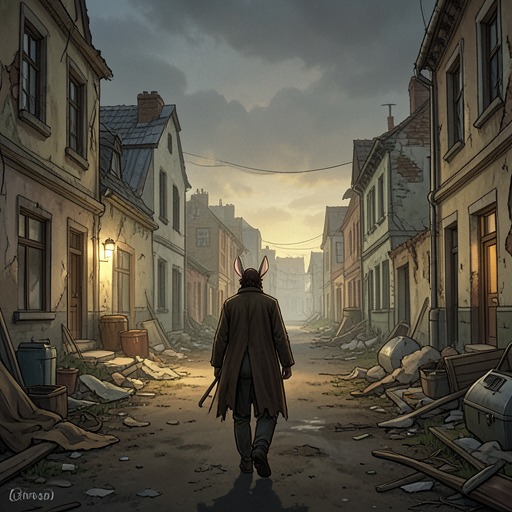
Defeating the Wraith of Threewells
Cinnamon BunDefeating the Wraith of Threewells is the turning-point battle of Broccoli Bunch’s early adventure: an encounter in which a seemingly gentle Cinnamon Bun’s defining virtue, Cleaning, becomes an instrument of combat and purification. The wraith is not merely an enemy to be struck down. It is a creature sustained by the evil mana rising from an opened pit, and its defeat establishes the practical force of Broccoli’s unusual class while transforming the abandoned settlement’s most immediate supernatural threat into a completed victory.
The Threat at the Evil Well
The confrontation begins at the opened pit in Threewells, where the wraith hovers above the hole, twisting and writhing as though in pain while simultaneously seeming to relish the sensation. Its howls and ecstatic moans accompany jolts of an unknown force coursing through its body. Broccoli infers that the creature is feeding on whatever comes from below, perhaps evil mana, but cannot identify the substance with certainty. The uncertainty matters: the danger is visible in the wraith’s body and behavior, while the source empowering it remains concealed beneath the ground.
Broccoli uses Insight to identify the enemy and receives the stark assessment of an evil wraith, level 2. The classification confirms that the creature is dangerous, but it does not turn the encounter into a simple extermination. Broccoli’s response is shaped by a moral reluctance to attack without warning. Even after deciding that the wraith is probably not friendly, Broccoli insists on trying to speak first rather than striking an unaware opponent. That impulse reflects the Cinnamon Bun class description, which presents Broccoli as a pure support and friend whose purpose is to cleanse the world’s impurities in the name of love and justice. The battle therefore begins as both a tactical problem and a test of whether compassion can coexist with necessary violence.
Preparation and Opening Exchange
Before approaching, Broccoli leaves the backpack on the doorstep of a nearby home and reviews a deliberately simple plan. The first stage is to attack with the showerhead-flail, followed by throwing the magic wand through the wraith; if the creature becomes sufficiently distracted, Broccoli will use the cleaning spell to cleanse it. The equipment is improvised rather than heroic, and the plan depends less on overwhelming strength than on creating brief openings. Broccoli’s preparation also includes eating another spoonful of honey while considering the available skills, a small domestic gesture that contrasts with the supernatural danger waiting beside the pit.
Broccoli steps into the morning sunlight with mana restored to its maximum, the makeshift flail hanging at the side and a determined frown on the face. From a distance of only a few dozen paces, Broccoli calls out, “Hello!” The wraith stops its strange movement and turns, producing an immediate physical reaction of fear: Broccoli’s blood runs cold. The greeting does not establish a peaceful exchange. Instead, it marks the point at which the creature’s attention shifts fully toward its opponent.
The initial attack reveals the limitations of Broccoli’s resources. A first use of Cleaning magic can destroy an ordinary ghost, as shown when the spell shoots into a ghost at close range and makes it burst apart. Against the wraith, however, the same power is not immediately decisive. The larger creature resists the first pressure of the encounter, forcing Broccoli to combine magic with repeated physical attacks rather than relying on a single cleansing discharge.
The Battle and Its Reversal
Broccoli spins the flail until it hums through the air. When the wraith charges, the weapon crashes into its hand, producing a burst of magic and changing the creature’s cry from anger to pain. That moment gives Broccoli the opening required by the original plan. Broccoli lunges forward, presses a hand against the wraith’s chest, apologizes, and commands, “Clean!” The spell begins to spread from the point of contact. A patch forms around Broccoli’s hand and expands outward in a growing circle, showing that Cleaning is not merely a household skill but a direct means of removing the corruption sustaining an undead body.
The cost is immediate. Mana falls rapidly as Broccoli pours more power into the attempt, eventually reaching zero. The failed timing creates the battle’s most dangerous reversal. Broccoli can no longer maintain the spell and recognizes the chance to retreat, recover mana, and devise another strategy. Instead, Broccoli stumbles after the wraith. The pursuit is physically compromised, but it keeps pressure on the enemy at the precise moment when the creature turns back toward the evil mana and leaves itself exposed.
The flail then performs the kind of brutal, improvised work that Broccoli’s class identity seems to contradict. It rams into and through the wraith’s body, cutting away its lower half and reducing that section to dust. The injury weakens the creature but does not end the fight. The wraith spins and rakes Broccoli’s face and chest with the backs of its claws, sending Broccoli several feet through the air. When Broccoli lands on the back, the threat of talons spearing into the ground forces an immediate roll to the side. A second, awkward strike with the flail pushes the wraith’s hands away, but Broccoli has only one point of mana available.
That single point becomes enough to preserve the fight. Broccoli slaps a hand against the wraith’s screeching face and fires Cleaning again. The resulting burst is brief, but it makes the weakened creature race backward and creates room for Broccoli to scramble upright. Broccoli then taunts the monster as a “big, fat meaniehead,” an ineffective but revealing attempt to compensate for physical vulnerability with nerve and distraction. The next flail attack lands, followed by another and another. Victory does not arrive as a single glorious blow; it emerges through a sustained beatdown in which every successive strike meets an enemy increasingly unable to fight back.
Victory and Consequences
The encounter ends when the system announces that Broccoli has laid “The Wraith of Threewells by Darkwood,” level 2, to rest. The wording frames the result as more than ordinary destruction. The wraith is not simply killed; it is laid to rest, a formulation consistent with Broccoli’s cleansing role and with the possibility that the creature’s corruption, rather than its mere existence, is what must be removed. The system also grants bonus experience because Broccoli savaged a monster above Broccoli’s level, converting the danger of the fight into measurable advancement.
The reward confirms several consequences at once. Broccoli’s Cleaning spell has proven capable of damaging an undead opponent whose strength exceeds Broccoli’s own, but only when supported by timing, improvised weapon use, and continued movement. The battle also demonstrates the practical meaning of the Cleaning skill, whose stated function is to improve the ability to clean faster and better. In Threewells, that progression crosses from sanitation into magical violence: the same principle that enables Broccoli to scrub a floor with a showerhead and mop becomes a force that can break apart ghosts and strip a wraith of its supernatural substance.
The victory closes the immediate threat at the evil well and leads directly into the next stage of the adventure, marked by the transition to “Dungeon Dive.” Broccoli has not solved every mystery associated with the pit or identified everything feeding the wraith, but the level-two undead guardian is no longer preventing further action. The result is therefore both an ending and a threshold: Threewells is made safer at the point of confrontation, while Broccoli’s experience, confidence, and combat method carry forward into the dungeon expedition.
Significance of Cleaning as Combat
The battle’s central irony is that Broccoli’s most distinctive power appears harmless until the setting redefines what counts as dirt. Broccoli is a Cinnamon Bun described as “Too good for this world,” a pure support and friend whose stated mission is to cleanse impurities through love and justice. Yet the wraith, the evil mana beneath the well, and the undead presences of Threewells turn impurity into an active physical threat. Cleaning consequently becomes a classification system as well as a skill: it distinguishes what can be restored from what must be forcibly purged, and it allows Broccoli to answer corruption without adopting the identity of a conventional killer.
The contrast is visible in the battle’s method. Broccoli apologizes before casting the cleansing spell, continues trying to address the enemy even after recognizing its danger, and still ends the encounter through repeated blows from a repurposed showerhead. Compassion does not prevent violence; it determines the meaning Broccoli gives to that violence. The wraith is treated as something that can be laid to rest, while its corrupting force is treated as something that can and should be cleaned away.
This combination of innocence, disgust, improvisation, and endurance defines the encounter’s narrative importance. Broccoli’s later understanding of combat as movement, Cleaning magic, and ranged or supportive contribution is already foreshadowed here, even though the victory is achieved at close range and with an improvised flail. The wraith is defeated not because Broccoli suddenly becomes a different kind of adventurer, but because the apparently unsuitable Cinnamon Bun class contains a form of power the surrounding world has underestimated.